
Avatar

Fullstack, Data, ML

Balancing between overfitting my models and underfitting my deadlines

Projects

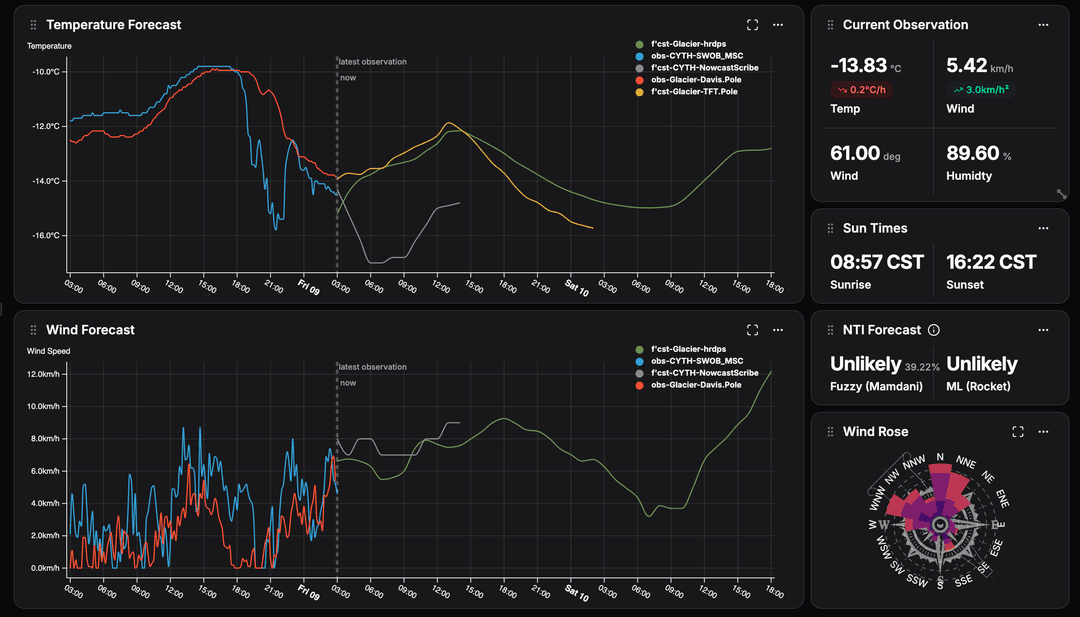
Glacier Wx
Glacier Wx
Oct 2025New

Cold weather test & operational planning dashboard

TypeScriptReactNext.jsD3.jsPythonPyTorch+2
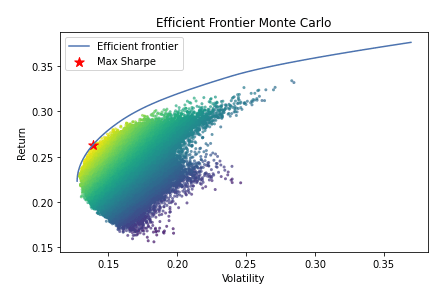
Efficient Frontier S&P 500
OLPSBandit
May 2025New

A Multi-armed Bandit Framework for Portfolio Selection

PythonPyTorchTypeScriptNext.jsReactGit
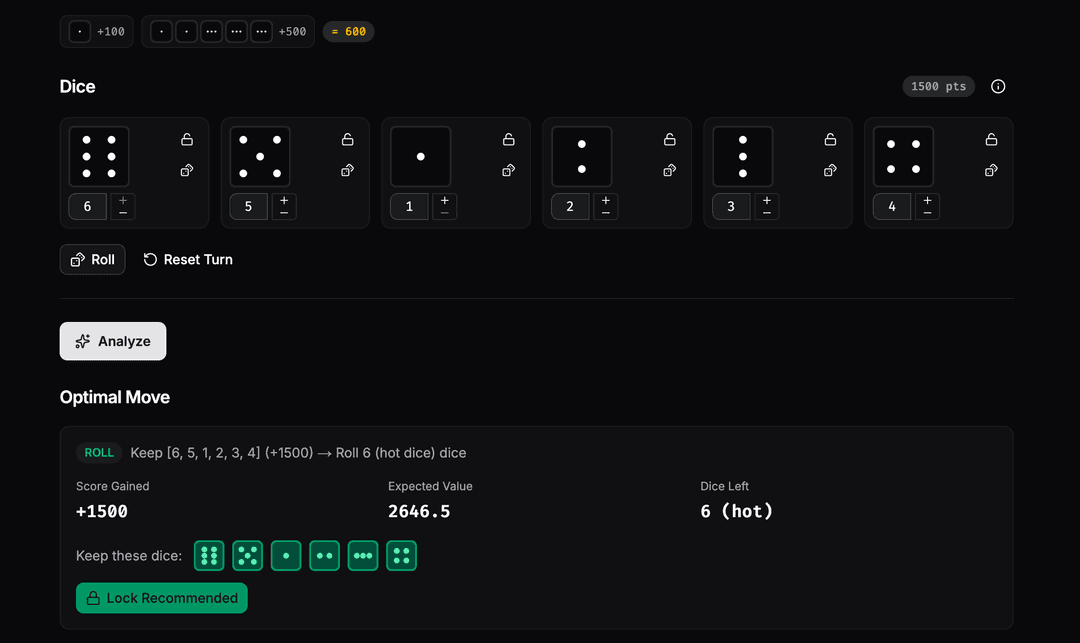
Codebreakers
Sep 2024

I don't lose at boardgame night anymore

ScaleSFL
ScaleSFL
May 2022

A Sharding Solution for Blockchain-Based Federated Learning

PyTorchTypeScriptNode.jsDockerGit
Füd
Füd
Dec 2020

A Food Delivery Application

JavaScriptNode.jsGit
Soundbox
Soundbox
Apr 2020

A Music Management Application

AndroidGit

Publications

2022-01-01
IEEE 10th International Conference on Healthcare Informatics (ICHI)

A deep learning based predictive model for healthcare analytics

Nguyen Duy Thong Tran, Carson K Leung, Evan Madill, Phan Thai Binh

Abstract

Healthcare informatics is an interdisciplinary area where computer science, data science, cognitive science, informatics principles, and information technology meet to address problems and support healthcare, medicine, public health, and/or everyday wellness. In many medical and healthcare applications, having models that can learn from historical healthcare data or instances to make predictions on future instances is helpful. However, partially due to privacy issues, the availability of healthcare data to be learned may be limited. Hence, in this paper, we present a deep learning based predictive model for healthcare analytics. In particular, our model consists of an autoencoder (comprising an encoder and a decoder) and a predictor to make accurate predictions. It can learn from a few shots of historical healthcare data to make either binary or multi-label predictions. Evaluation results on real-life datasets demonstrates the effectiveness of our deep learning-based predictive model in supporting healthcare analytics.

2022-01-01
IEEE 10th International Conference on Healthcare Informatics (ICHI)

Towards trustworthy artificial intelligence in healthcare

Carson K Leung, Evan Madill, Joglas Souza, Christine Y Zhang

Abstract

Healthcare informatics is an interdisciplinary area where computer science, data science, cognitive science, informatics principles, and information technology meet to address problems and support healthcare, medicine, public health, and/or everyday wellness. In many healthcare and medical applications, it is helpful to have models that can learn from historical healthcare data or instances to make predictions on future instances. For human to trust these models or to perceive these models to be trustworthy, it is equally important to build a trustworthy artificial intelligence (AI) solution. Hence, in this paper, towards trustworthy AI in healthcare, we present an explainable AI (XAI) solution that makes accurate predictions and explains the predictions. Evaluation results on real-life datasets demonstrates the effectiveness of our XAI solution towards trustworthy AI in healthcare.

2022-01-01
Proceedings of the Fourth ACM International Symposium on Blockchain and Secure Critical Infrastructure
Award

ScaleSFL: A Sharding Solution for Blockchain-Based Federated Learning

Evan Madill, Ben Nguyen, Carson K Leung, Sara Rouhani

Abstract

Blockchain-based federated learning has gained significant interest over the last few years with the increasing concern for data privacy, advances in machine learning, and blockchain innovation. However, gaps in security and scalability hinder the development of real-world applications. In this study, we propose ScaleSFL, which is a scalable blockchain-based sharding solution for federated learning. ScaleSFL supports interoperability by separating the off-chain federated learning component in order to verify model updates instead of controlling the entire federated learning flow. We implemented ScaleSFL as a proof-of-concept prototype system using Hyperledger Fabric to demonstrate the feasibility of the solution. We present a performance evaluation of results collected through Hyperledger Caliper benchmarking tools conducted on model creation. Our evaluation results show that sharding can improve validation performance linearly while remaining efficient and secure.

2021-01-01
IEEE/WIC/ACM International Conference on Web Intelligence and Intelligent Agent Technology

A Web Intelligence Solution to Support Recommendations from the Web

Carson K Leung, Evan Madill, Sehaj P Singh

Abstract

Big data are everywhere. World Wide Web and social networks are examples of these big data. They have become a vast data production and consumption platform, at which threads of data evolve from multiple devices, by different human interactions, over worldwide locations, under divergent distributed settings. Embedded in these big web data is implicit, previously unknown and potentially useful information and knowledge that awaited to be discovered. This calls for web intelligence solutions, which make good use of data science, data mining (especially, web mining) and social network analysis to discover useful knowledge and important information from the web (e.g., web of people/things). Such a web often consists of vertices (i.e., people/things) and edges (i.e., connections among people/things). When modeling a social network as a web of people, these edges can be undirected (e.g., for mutual friendships) or directed (e.g., for capturing a social entity who is following another social entity). In this paper, we present a web intelligence solution to discover interesting knowledge (e.g., most-followed people or most-referenced web pages) from these social connections. Due to the dynamic nature of the web, vertices and/or edges may be changed (e.g., added or deleted) over time. Hence, our solution is designed in such a way that it discovers knowledge not only from a static web but also from a dynamic web. Evaluation on real-life web data demonstrates the effectiveness and practicality of our solution for discovering knowledge and supporting recommendations from the web.